There is an awkward decade in vision correction. You are past the age where LASIK solves the problem, and years away from the cataracts that would make lens surgery routine and partly insured. You are holding the menu at arm's length, and nobody has given you a straight answer about what to do.
This is a guide to that decade — and why a growing number of US patients in their late forties and fifties handle it in Seoul.
What presbyopia actually is
Presbyopia is not a disease and it is not your eyes "getting weaker." The lens inside your eye gradually loses its ability to change shape, so it can no longer shift focus from far to near. It starts around 40–45, progresses for roughly fifteen years, and reaches essentially everyone.
The key point most people miss: LASIK cannot fix it. LASIK reshapes the cornea, but presbyopia is a problem with the lens behind it. A person who had perfect LASIK results at 28 will still need reading glasses at 46. That is not a failed procedure — it is a different problem.
The four real options
1. Reading glasses or progressives
Free of surgical risk, and for many people genuinely the right answer. If glasses do not bother you, stop here.
2. Monovision LASIK / PRK
One eye is corrected for distance, the other for near, and the brain adapts. Cheap relative to lens surgery and reversible in the sense that it only alters the cornea. The trade-off is reduced depth perception and a compromise in both distance and near sharpness. Most surgeons will trial it in contact lenses first — insist on that.
3. Refractive lens exchange (RLE)
The natural lens is removed and replaced with an artificial intraocular lens (IOL) — the identical operation to cataract surgery, performed before a cataract exists. A multifocal or EDOF (extended depth of focus) lens restores a range of focus.
This is the most definitive option, and the most consequential. It is irreversible, and it removes the possibility of a future cataract (you cannot get a cataract in an artificial lens).
4. Corneal inlays
Small implants placed in the cornea of the non-dominant eye. Offered in some markets, but uptake has fallen as lens technology improved. Most Korean specialists will steer you elsewhere.
Is it the same as cataract surgery?
Mechanically, yes — and that matters for how you judge it. Korean surgeons perform an enormous volume of lens procedures, which is exactly the experience base you want. The differences are:
| Cataract surgery | Refractive lens exchange |
|---|
| Reason | The lens has clouded | The lens has stiffened |
| Typical age | 65+ | 45–60 |
| US insurance | Often partly covered | Never covered |
| Lens choice | Standard or premium | Premium by default |
If you are over 60 and a cataract is already forming, read our cataract surgery guide instead — you may be better off waiting and doing one operation.
What it costs
| Procedure | United States | South Korea |
|---|
| Refractive lens exchange, premium lens (per eye) | $4,000–$8,000 | $2,500–$4,500 |
| Both eyes, premium multifocal/EDOF | $8,000–$16,000 | $5,000–$9,000 |
| Monovision LASIK (both eyes) | $4,000–$6,000 | $1,500–$3,000 |
Illustrative ranges in USD. High-end US clinics using premium lenses can exceed $12,000 per eye. Your quote depends on the lens model and your prescription.
Because RLE is elective in both countries, there is no insurance to offset it at home — which is why the gap decides the trip for many patients. Confirm the exact IOL model in writing; the lens is most of the cost and most of the result.
The trade-offs nobody puts on the brochure
An honest list, because this is permanent surgery on a healthy eye:
- Halos and glare at night. Common with multifocal lenses, especially in the first months. Most people neuroadapt; some never fully do. If you drive at night for a living, say so at consultation.
- It is irreversible. An IOL can be exchanged, but it is a second surgery with its own risks.
- Reading glasses may still be needed for fine print or dim light. "Glasses-free" is a marketing word, not a guarantee.
- Retinal detachment risk is higher after lens exchange in people with high myopia. This is the single most important thing to raise if you are very nearsighted — a good surgeon will bring it up before you do.
- Posterior capsule opacification affects a meaningful share of patients months to years later. It is fixed with a quick in-office YAG laser — but you will likely be back in the US by then, so ask who handles it.
Why Korea for this specifically
- Volume. Korean ophthalmology clinics perform lens and refractive procedures at a scale that builds real surgical judgment — not just technique.
- Lens access. The current generation of multifocal, EDOF and toric IOLs is widely stocked, without the approval lag some markets face.
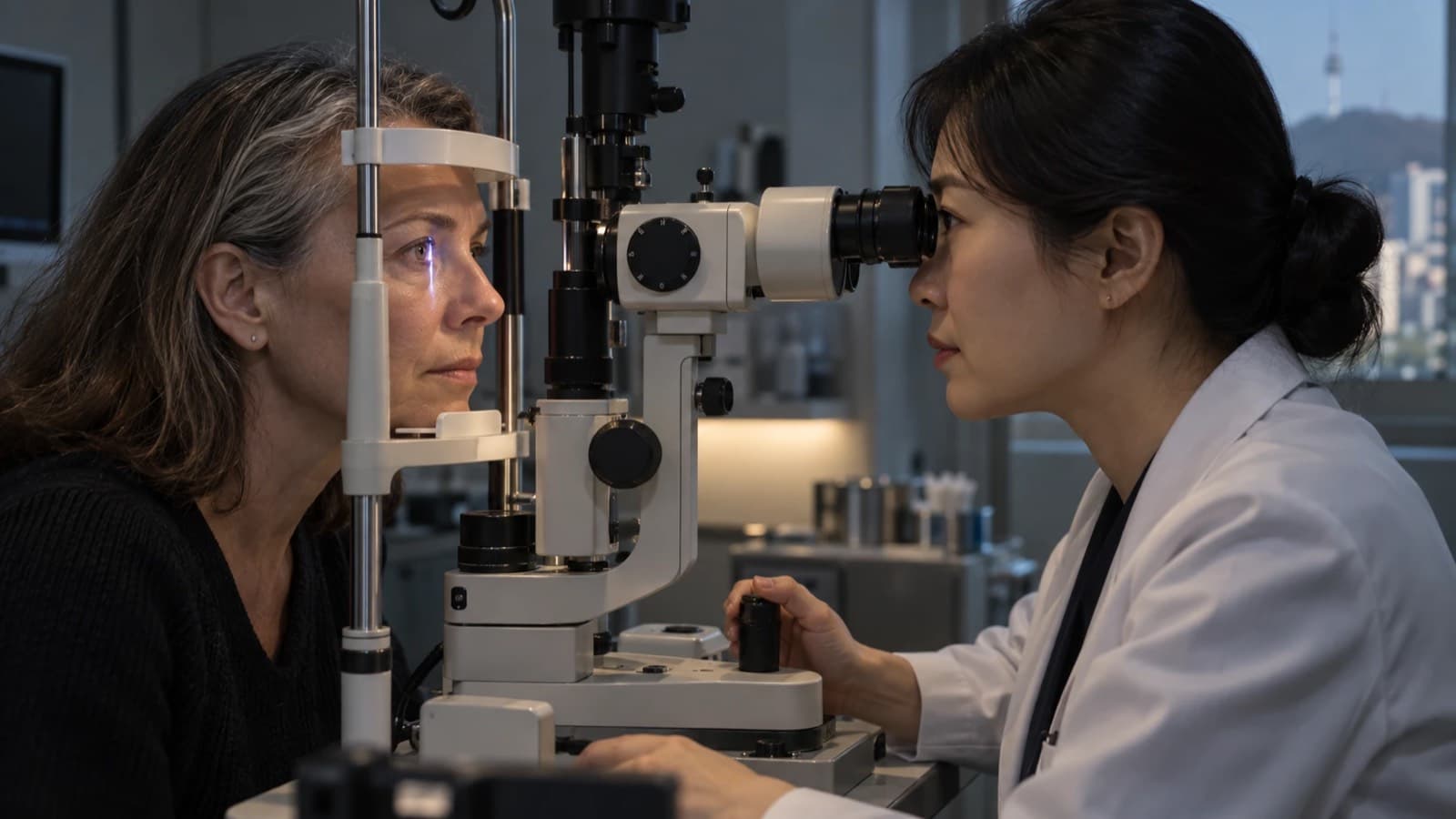
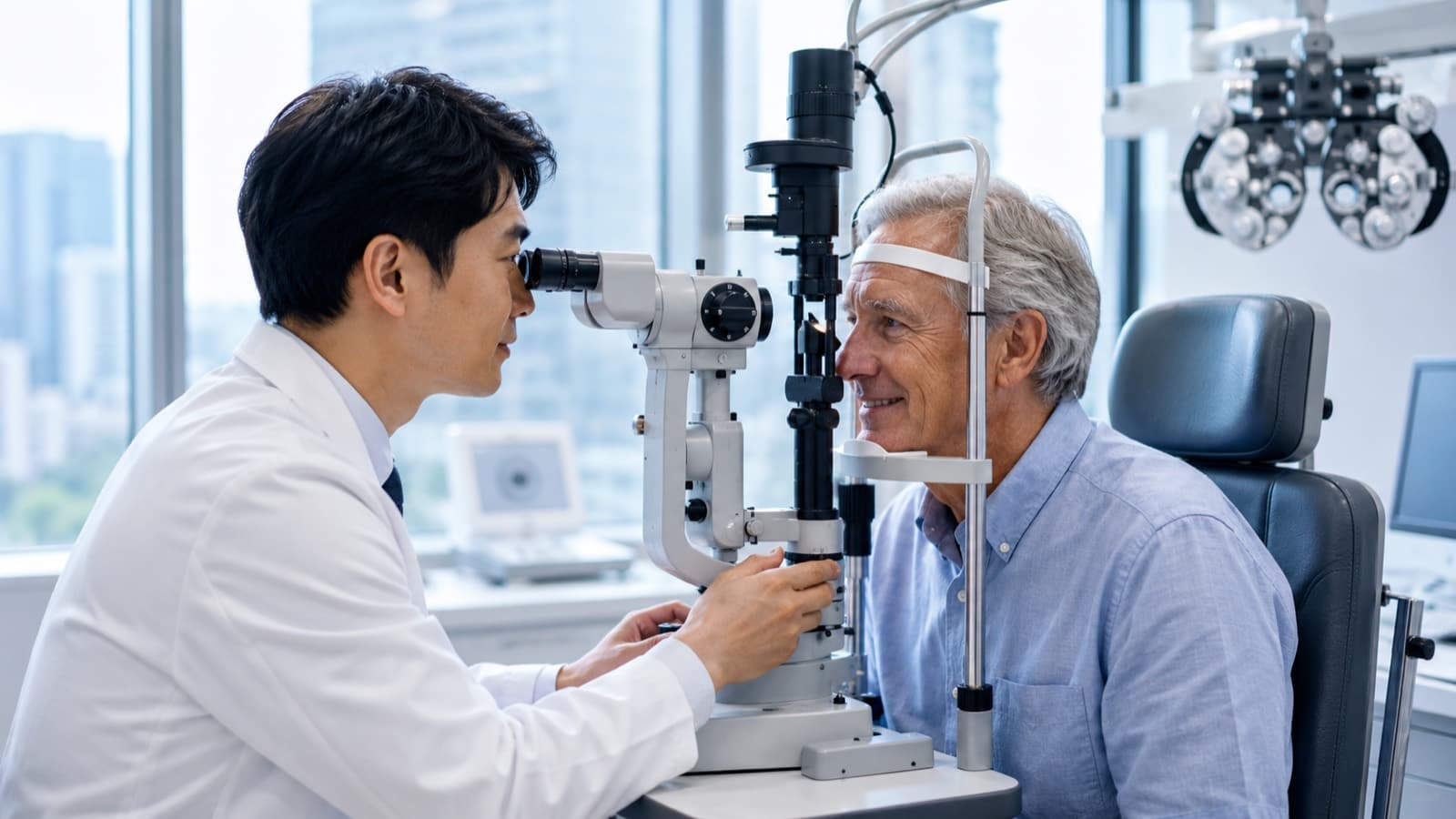
- Same-day diagnostics. Corneal topography, biometry, macular OCT and dry-eye assessment are typically completed in a single visit, so you get a real answer fast.
Planning the trip
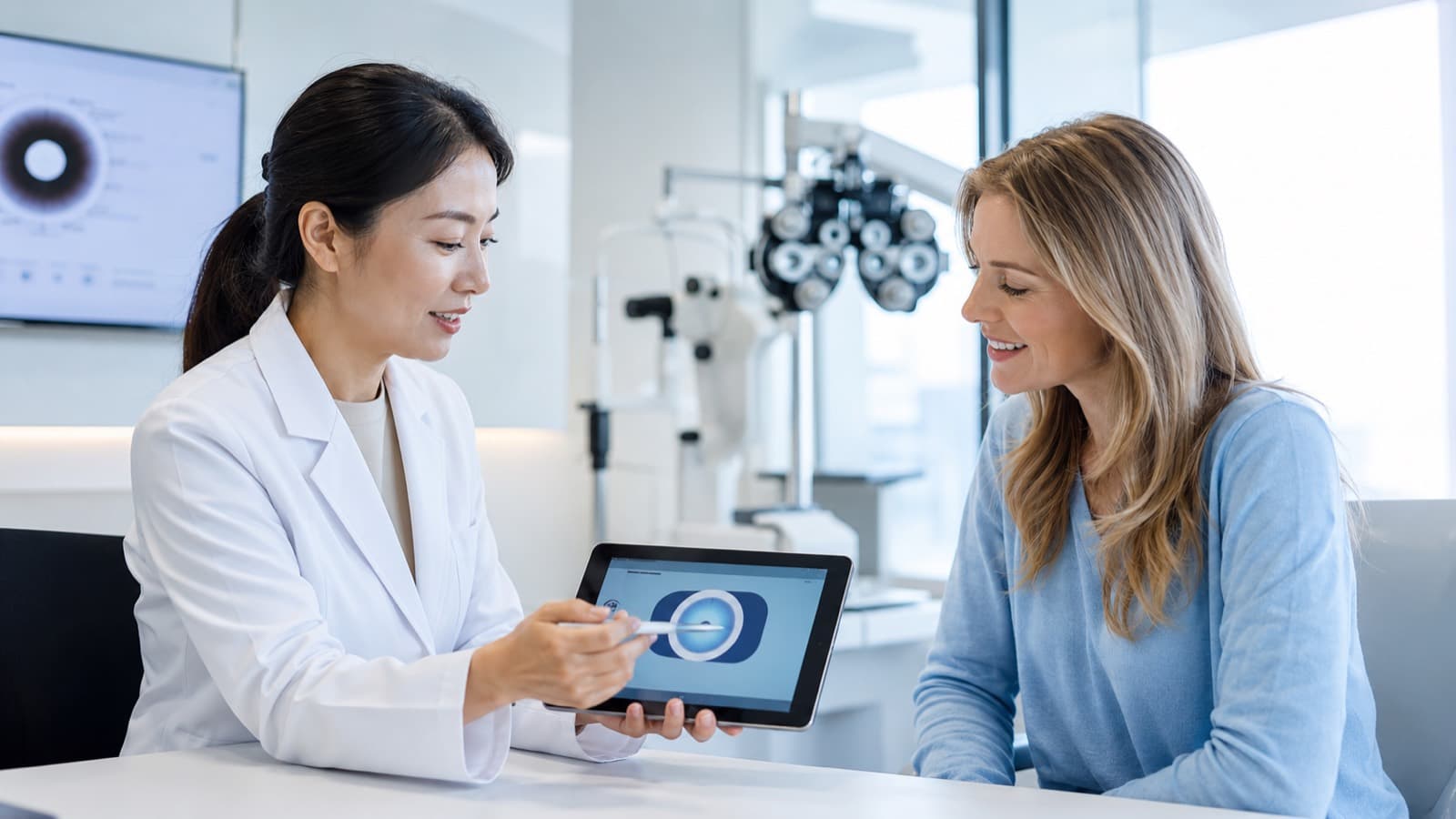
- Day 1: full diagnostic workup and consultation. A responsible clinic may tell you that you are not a candidate — treat that as a good sign.
- Day 2–3: first eye. Most clinics operate the second eye a few days later.
- Stay 7–10 days total so your surgeon can check both eyes before you fly.
- Bring your current prescription, any prior LASIK records, and a list of medications.
- Arrange US follow-up before you leave Korea — who sees you at one month, and who handles a YAG laser later.
For related procedures, see our guides to LASIK, ICL, and SMILE.
How Curo helps
Curo is a registered patient-attraction agency, not a clinic. A Korean doctor reviews your case and matches you with a board-certified ophthalmologist, and you pay the clinic's own price — no foreigner markup. Booking and interpretation are free. Explore vision correction in Korea, read the LASIK guide, or get a free quote.
Este contenido es información general y no constituye consejo médico. Las decisiones de tratamiento personales requieren una consulta con su médico tratante. Curo es una agencia de atracción de pacientes internacionales registrada ante el Ministerio de Salud y Bienestar de Corea y no es una institución médica.