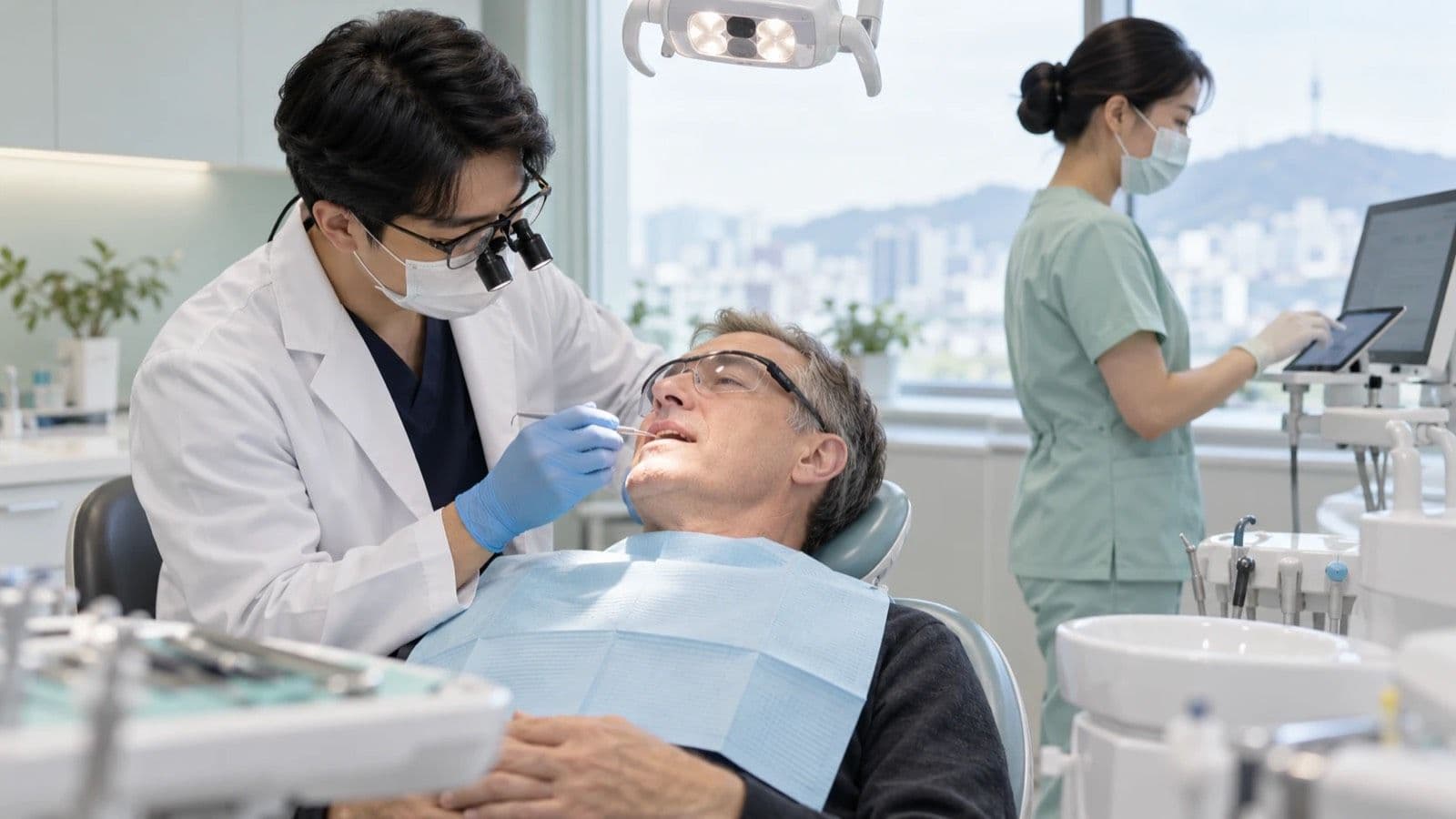
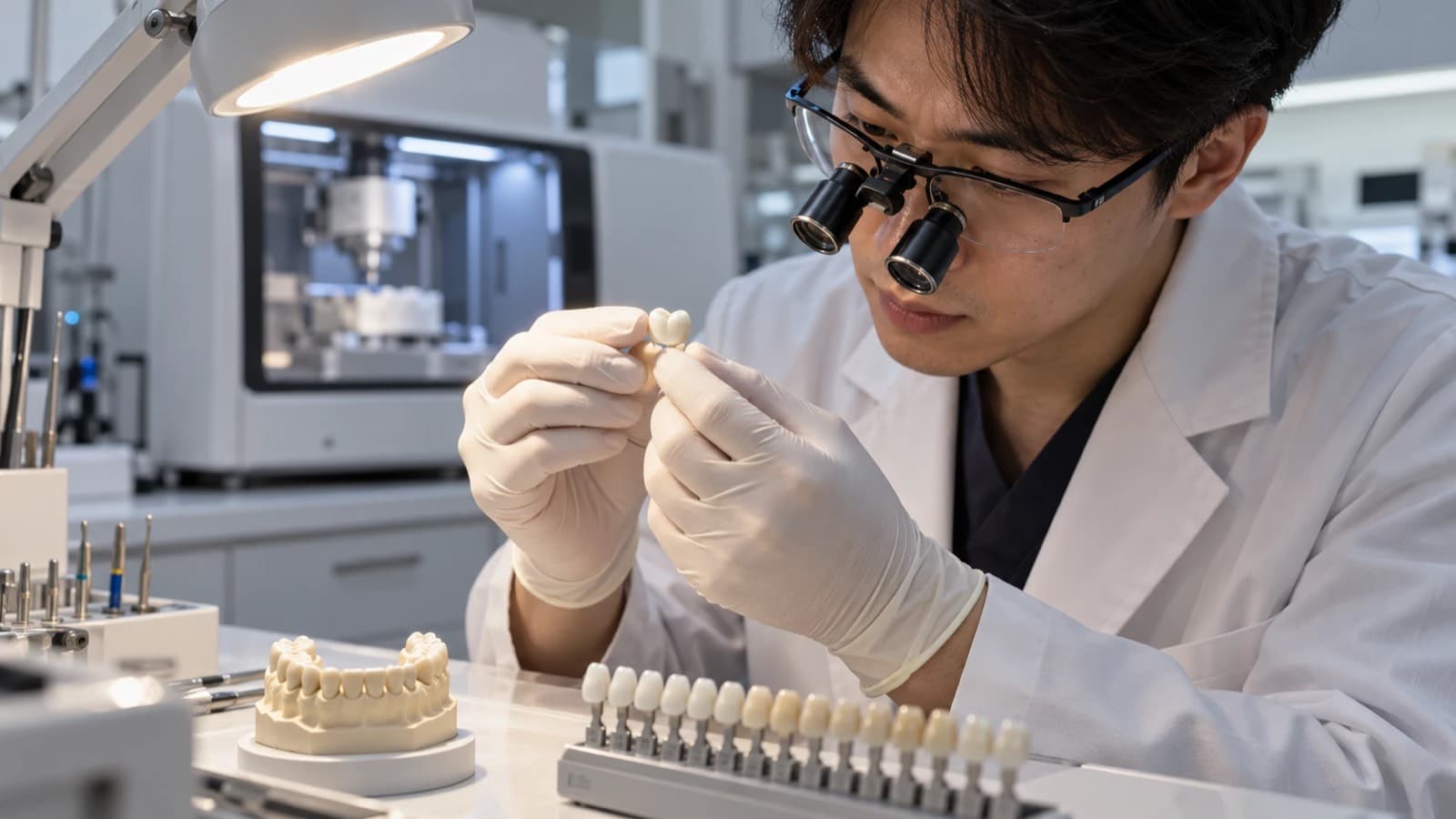
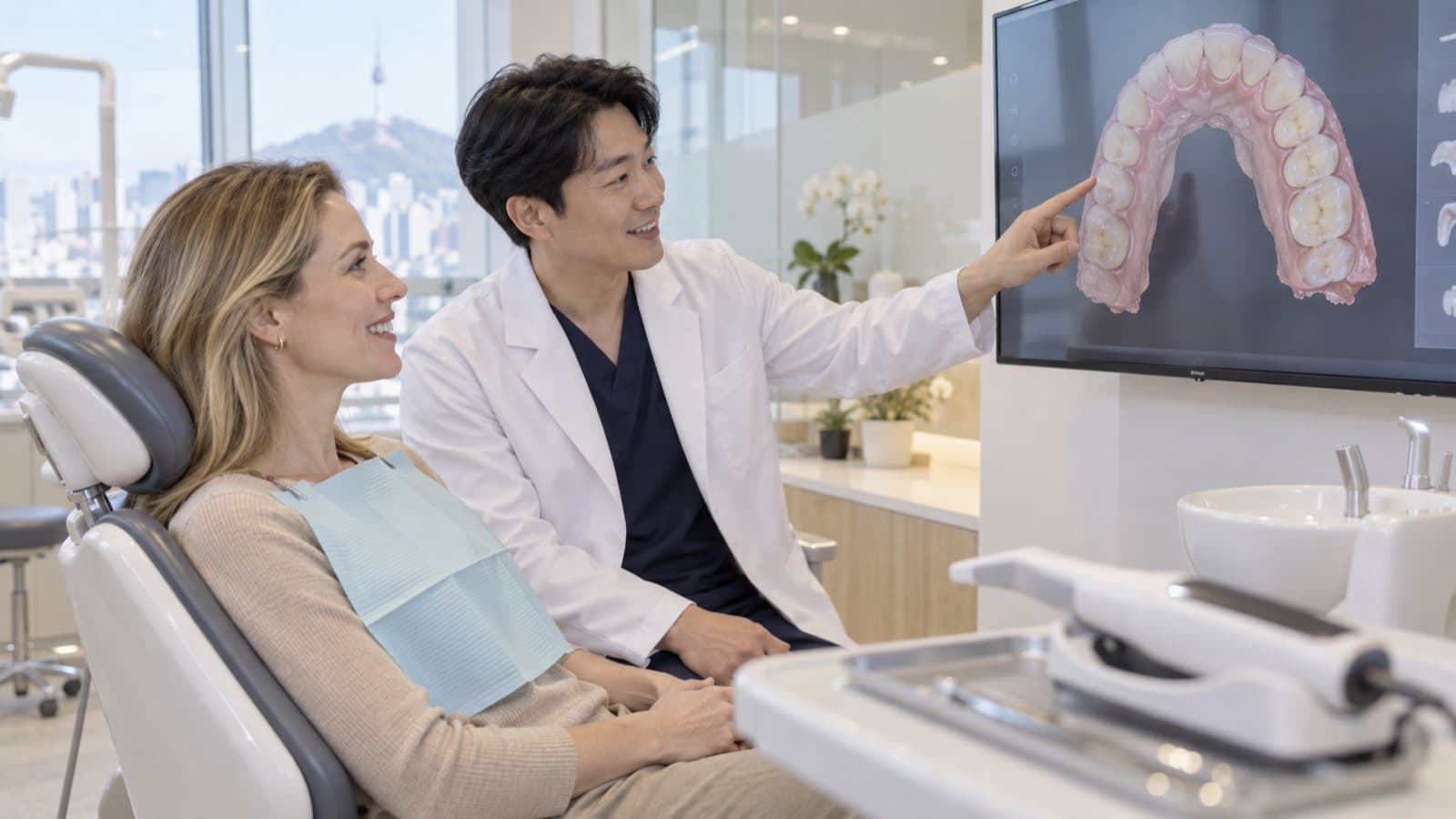
Here is the sequence problem almost every dental-travel plan gets wrong: people arrive in Seoul for implants or veneers, and the first thing the dentist has to tell them is that their gums are not ready.
Gum disease is the foundation question. Everything cosmetic sits on top of it.
Why this comes first
An implant is anchored in bone. Periodontal disease destroys bone. Placing implants into an untreated periodontal patient is the single most reliable way to produce peri-implantitis — the same inflammatory process attacking the implant instead of a natural tooth — and implant failure years later, usually after the patient has flown home.
Veneers and crowns have a different but equally decisive problem: if the gum line recedes after treatment, the margin of the restoration becomes visible. The expensive smile ages badly, fast.
A good Korean clinic will tell you this and sequence the work. A clinic that quotes you for veneers without examining your gums is quoting for a problem it has not looked at.
The two stages, and why the difference matters
- Gingivitis — inflammation of the gums only. Bleeding when brushing, redness, swelling. Fully reversible with professional cleaning and better home care. No bone has been lost.
- Periodontitis — inflammation has progressed below the gum line and is destroying the bone that holds your teeth. Pockets form, teeth loosen, gums recede. The lost bone does not come back.
The honest framing: periodontitis is managed, not cured. Treatment stops the progression and stabilises what you still have. That is a genuinely good outcome — but it is not a restoration of what was lost.
What a Korean periodontal workup includes
- Full-mouth periodontal charting — pocket depth measured at six points per tooth. This is the actual diagnosis, and it is often skipped.
- Full-mouth X-rays or CBCT — to see bone levels, not just gum appearance.
- Mobility and recession assessment
- Occlusal check — grinding and bite forces accelerate bone loss and are routinely missed
Ask for your pocket-depth chart in writing. Numbers of 1–3 mm are healthy, 4–5 mm is early disease, 6 mm and above is advanced. It is the one dental measurement you can track yourself over years.
Treatments, from least to most involved
- Scaling — routine cleaning above the gum line.
- Scaling and root planing (deep cleaning) — cleaning below the gum line, usually under local anaesthetic, done by quadrant. The workhorse treatment for early-to-moderate periodontitis.
- Laser-assisted periodontal therapy — adjunct to deep cleaning in some clinics.
- Flap surgery — the gum is lifted to access and clean deep deposits, then re-sutured. For pockets that do not respond.
- Bone grafting / guided tissue regeneration — rebuilding bone support in selected defects.
- Gum (connective tissue) grafting — covering exposed roots where recession has progressed.
What it costs
| Procedure | United States | South Korea |
|---|
| Routine scaling / cleaning | $100–$250 | $30–$80 |
| Deep cleaning (scaling + root planing, full mouth) | $800–$2,000 | $100–$300 |
| Periodontal flap surgery (per quadrant) | $1,000–$3,000 | $300–$700 |
| Gum graft (per site) | $1,000–$3,000 | $400–$900 |
| Bone graft (per site) | $600–$1,200 | $200–$500 |
Illustrative ranges in USD. Your quote depends on how many quadrants and sites are involved.
Korea has an unusual advantage here that is worth naming: scaling is routine and inexpensive because it is covered annually for Korean residents under national insurance, so clinics perform it at enormous volume. The skill and the pricing both reflect that.
What fits in a trip
- Deep cleaning (all four quadrants) — comfortably within 3–5 days, often two visits.
- Flap surgery or grafting — add 7–10 days and sutures to remove before you fly.
- Implants after periodontal treatment — this is the sequencing that matters. Gums should be stable for roughly 3 months before implant placement. In practice that means two trips: periodontal work first, implants on the return visit. See dental implants in Seoul and All-on-4.
- Veneers and crowns — gums must be healthy and stable first, or the margins will show later. See crowns and bridges and veneers.
The part that happens at home
Periodontal treatment succeeds or fails on maintenance, and maintenance is not something you can fly to.
- 3–4 month recall cleanings, not the standard 6 months, for anyone with a periodontitis diagnosis.
- Daily interdental cleaning — floss or interdental brushes. Brushing alone does not reach where the disease lives.
- Smoking is the single largest modifiable risk factor and substantially worsens outcomes, including implant survival.
- Diabetes control — the relationship runs both ways; poorly controlled blood sugar worsens gum disease and vice versa. Our men's and women's screening guides cover the relevant testing.
Being direct: if you cannot commit to maintenance, implants are a poor investment regardless of where you have them placed. That is worth knowing before you book a flight, not after.
Planning from the US
- Bring recent X-rays or a CBCT, any previous periodontal charting, and your medication list — several common medications affect gum tissue.
- Budget 3–5 days for non-surgical treatment, 7–10 if surgery is likely.
- Arrange your US recall before you leave. A hygienist at home every 3–4 months is what protects the work.
For the wider dental picture, start with our Korean dental care guide and K-dentistry overview.
How Curo helps
Curo is a registered patient-attraction agency, not a clinic. A Korean doctor reviews your case and matches you to a doctor-vetted dental clinic — including sequencing periodontal treatment before cosmetic or implant work rather than selling you the visible part first. You pay the clinic's own price, no foreigner markup. Explore dental care in Korea or get a quote.
This content is general information and not medical advice. Personal treatment decisions require consultation with your treating physician. Curo is a Ministry of Health & Welfare–registered international patient attraction agency and is not a medical institution.