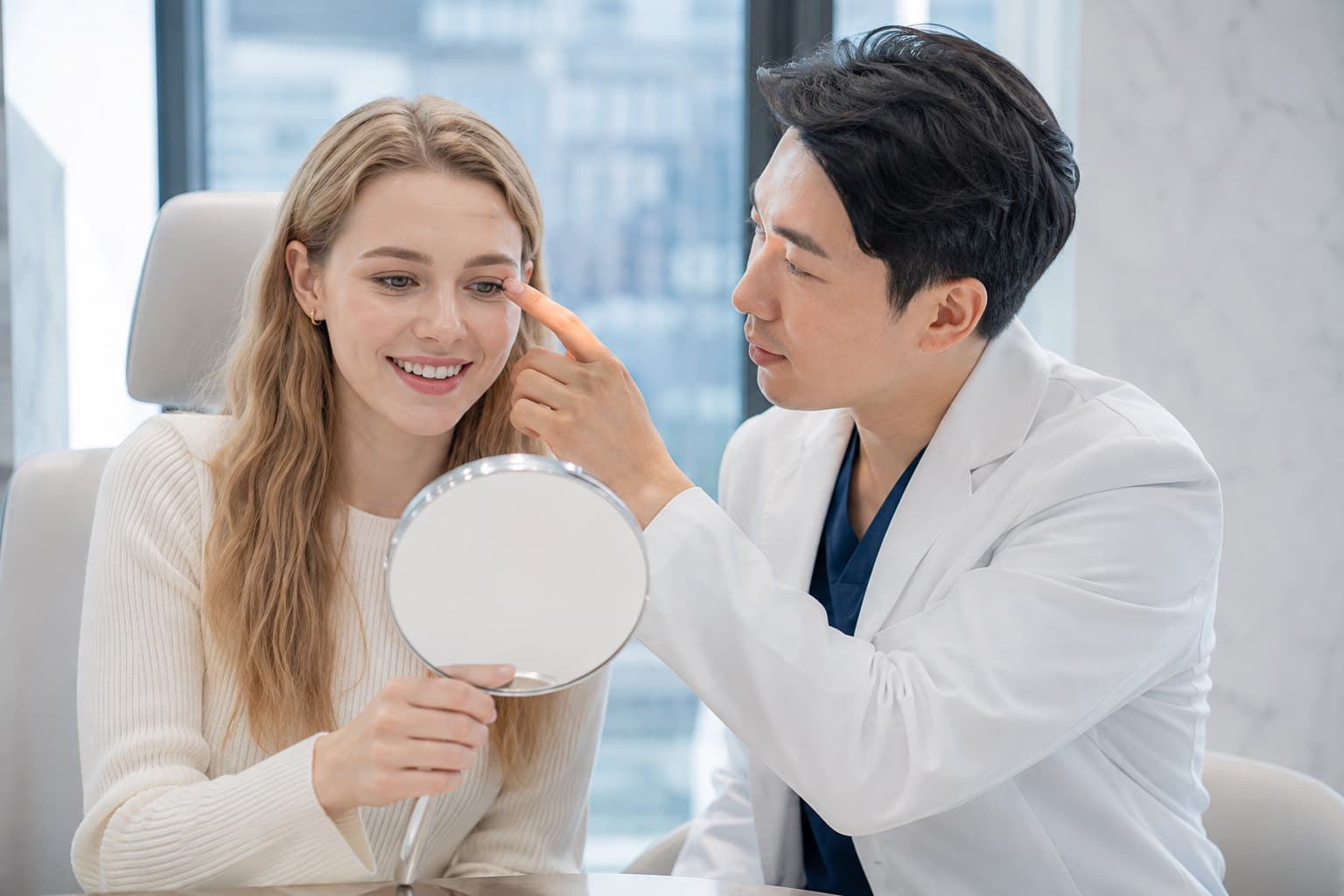
Every guide tells you to "choose a reputable clinic." Almost none tells you how, from eight thousand miles away, in a language you don't read.
This is the practical version. It applies to every specialty, and the first item matters more than all the others combined.
This is general information to help you ask better questions, not medical or legal advice.
1. Verify the doctor, not the clinic
The single most important distinction in Korean healthcare, and the one US patients almost never know:
- 의사 (uisa) — a licensed doctor. Has a medical licence.
- 전문의 (jeonmun-ui) — a board-certified specialist. Has completed six years of medical school, a one-year internship, and roughly four years of residency in a defined specialty, then passed a separate board exam.
A licensed doctor without specialty training can legally perform many cosmetic procedures in Korea. The clinic's marketing will say "doctor." It will not usually say which kind.
The specialty you want depends on the work:
| Treatment | Ask for |
|---|
| Plastic / cosmetic surgery | 성형외과 전문의 — plastic surgery specialist |
| Dermatology, lasers, injectables | 피부과 전문의 — dermatology specialist |
| Eye surgery | 안과 전문의 — ophthalmology specialist |
| Implants, crowns | 보철과 전문의 — prosthodontics specialist |
| Braces, aligners | 치과교정과 전문의 — orthodontics specialist |
How to actually check it
Ask the clinic in writing for the doctor's full name in Hangul (한글). This is the step that unlocks everything else — Korean professional registries search by Korean script, not romanised names, and "Dr. Kim" is unsearchable.
With the Hangul name you can search the relevant society's member directory — for plastic surgery, the Korean Society of Plastic and Reconstructive Surgeons (대한성형외과학회). A clinic that hesitates to give you the operating doctor's name in writing has told you something.
2. Confirm who will actually operate
Korea has a documented history of "ghost surgery" — a different doctor performing the operation after the patient is under anesthesia. It became a national issue after the death of a patient, Kwon Dae-hee, whose CCTV footage showed the booked surgeon leaving the operating room mid-procedure.
Korea responded with a law most countries do not have. Under an amendment to the Medical Service Act passed in 2021 and in force since 25 September 2023, medical institutions that operate on patients under general anesthesia or sedation must have CCTV in the operating room, and the patient can request that the surgery be recorded.
Two things to understand about it:
- Recording is on request, not automatic. You have to ask, in advance, and institutions are required to post notice that filming is possible.
- There are documented grounds for refusal — emergency surgery, high-risk life-saving intervention, and teaching-hospital training. A refusal must be recorded with its reason.
So the practical steps are: get the operating surgeon named in your written consent, and request operating-room recording when you book, not on the morning of surgery. Reported retention periods and procedural details vary between sources, so confirm the specifics with the hospital directly.
This applies only to procedures where you will be unconscious. For an awake laser or filler appointment it is moot — but then, so is the ghost-surgery risk.
3. Check the anesthesia
For anything under general anesthesia, ask whether a board-certified anesthesiologist (마취통증의학과 전문의) is present for the whole procedure — not a nurse, and not the operating surgeon monitoring their own patient.
This is the question most strongly associated with the serious adverse events that make the news, and it costs the clinic money to answer "yes." Ask it.
4. Confirm foreign-patient registration
Korea's Ministry of Health and Welfare maintains a registry of medical institutions permitted to attract and treat international patients, and a separate one for the agencies that refer them. Unregistered operators exist.
Ask the clinic for its registration, and ask the same of whoever is arranging your trip. (Curo is a registered patient-attraction agency; you can ask us for ours.)
5. Read the quote like a contract
A legitimate quote is itemised and names things. It should state:
- The operating doctor by name
- Surgeon's fee, anesthesia, facility, materials (brand and model of any implant, lens, or graft)
- What pre-op workup is included
- How many post-op visits are included
- The revision and refund policy, and for how long it runs
- What is explicitly not included
"All-inclusive package: $X" is not a quote. It is a number.
6. Treat reviews and before-and-afters as marketing
- Incentivised reviews are common in Korean beauty and medical marketing — discounts in exchange for posts are normal practice, not a scandal. Assume a glowing Korean-language review may be compensated.
- Before-and-after photos are trivially flattered by lighting, angle, makeup and posture. Ask for pairs shot at the same angle and lighting, and for cases that resemble yours — your age, your anatomy, your starting point.
- Ask to see an unhappy case. A surgeon with real volume has had results that needed revision. One who claims never to have is either new or not being straight with you.
7. Settle complications before you fly
The questions, in order:
- If something goes wrong while I'm still in Korea, who treats it and who pays?
- If it goes wrong after I fly home, who do I contact, and in what language?
- Will you provide my operative report, imaging and medication list in English?
- Is there a hospital affiliation if I need inpatient care?
If the answer to (2) is vague, price the trip as though you will be handling it yourself, because you will.
Red flags
- The operating doctor is not named in writing
- Pressure to decide today, or "event pricing" with a deadline
- A price that drops after you hesitate
- A different price list for foreign patients
- Being upsold procedures you did not come for
- No in-person consultation before surgery
- Claims of zero complications, or a guaranteed result
- Refusal to discuss anesthesia staffing or recording
The short version
If you remember five things: get the doctor's Hangul name, confirm the specialty board, name the operating surgeon in the consent, ask about the anesthesiologist, and get an itemised quote. Those five filter out most of what goes wrong.
For specialty-specific detail, see our guides to plastic surgery costs, the step-by-step surgery process, dental work, and trip planning and logistics.
How Curo helps
This checklist is what Curo does before you ever see a clinic: a Korean doctor reviews your case, confirms the specialist credential, and matches you only with hospitals he would send his own family to. You pay the clinic's own price — no foreigner markup — and booking and interpretation are free. Curo is a registered patient-attraction agency, not a medical institution. Get a free quote or explore treatments.
This content is general information and not medical advice. Personal treatment decisions require consultation with your treating physician. Curo is a Ministry of Health & Welfare–registered international patient attraction agency and is not a medical institution.